
Disclosure: Some links on this page are affiliate links. We may earn a commission from qualifying purchases at no extra cost to you. As an Amazon Associate, we earn from qualifying purchases. How affiliate links work.
Zebra Swallowtail: the striped butterfly that depends on pawpaw
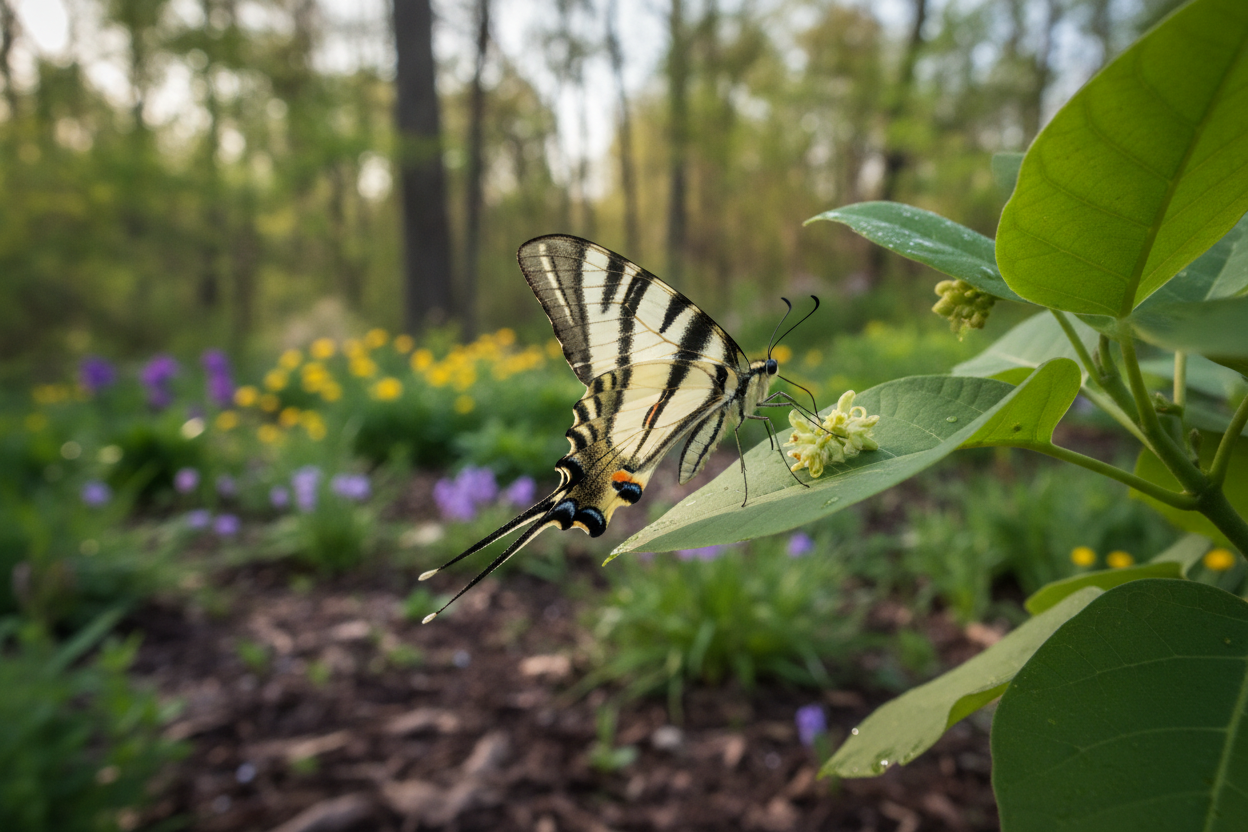
The Zebra Swallowtail is among the most striking butterflies in the Upstate: pale, kite-shaped wings marked with bold black stripes and trailed by long, thin tails. It is also one of the pickiest. Its caterpillars eat only pawpaw, so wherever pawpaw grows along a stream or in a woodland, this butterfly may be nearby, and wherever it does not, you will rarely see one.
This guide explains how to identify it, how the spring and summer forms differ, what its life cycle looks like, when and where to find it, and how to plant a pawpaw patch.
Zebra Swallowtail at a glance
- Scientific name: Eurytides marcellus (also listed as Protographium marcellus)
- Size: Wingspan of about 2.5 to 4 inches
- When to look: Late winter through fall in the South, with three or four broods
- Caterpillar plants: Pawpaw only
- Adult nectar plants: Blueberry, redbud, verbena, milkweed, Joe-Pye weed, lantana
- Habitat: Stream banks, moist woods and swamps where pawpaw grows
- Overwinters as: A chrysalis
- Ease of attracting: Specialist (needs pawpaw)
Ease of attracting runs from Easy (nectar flowers are enough) to Moderate (add a common host plant) to Specialist (needs one particular host plant).
How to identify a Zebra Swallowtail
The wings are triangular and pale green-white, with black stripes running lengthwise like the markings on a zebra. Each hindwing carries a long, narrow tail. The hindwing also has a red spot near the body and two blue spots near the tail, and the underside has a red stripe running through the middle. It is hard to confuse with any other butterfly in the Upstate.
Spring and summer forms
- Spring form: Smaller and whiter, with short black tails tipped in white.
- Summer form: Larger, with broader black stripes and longer black tails edged in white.
Both forms are the same species. The difference comes from the temperature and day length the caterpillar experiences. If you see a small, pale zebra in April and a larger, darker one in July, you are not seeing two kinds of butterfly.
Lookalikes
In the Upstate, nothing else has this look. If you see a pale butterfly with long tails and stripes, it is a Zebra Swallowtail. Do not confuse it with the Eastern Tiger Swallowtail, which is yellow and much larger.
The Zebra Swallowtail life cycle
Eggs
Females lay single eggs on pawpaw leaves and sometimes on twigs or the trunk. The eggs are round and pale green and turn orange-brown. Females fly slowly while they search for the right plant.
Caterpillars
Young caterpillars are black with lighter cross stripes. Older caterpillars are usually green with yellow and white stripes, though a rarer black form banded with white and orange also occurs. Both forms have a yellow, black and bluish-white band between the front and the back of the body. Like other swallowtails, they have a forked scent organ behind the head that smells unpleasant when it is extended. Caterpillars can be cannibals, so you rarely find many on one tree.
Pawpaw contains natural compounds that caterpillars take in. Those compounds stay in the butterfly’s body and may help protect it from birds.
Chrysalis
The chrysalis is green or brown and more compact than those of other swallowtails, with small horns on the head and body. In cold weather it overwinters, then emerges in spring.
Adult
Males patrol close to the host plants, flying swiftly and directly about 2 to 6 feet off the ground. Females fly more slowly. Males gather on damp sand, gravel or mud to take up salts and other nutrients, and they also feed on rotting fruit.
When and where to look in the Upstate
In the South, the flight season stretches from late winter into fall, with the first brood the largest. Look first in the early spring, when small, pale zebras appear near streams and moist woods. Search stream banks, bottomland woods and damp ravines where pawpaw grows. The butterfly rarely strays far from its host. See best Blue Ridge butterfly spots and butterflies in South Carolina by month for ideas.
Plants that bring them in
Pawpaw: the host plant
Pawpaw (Asimina triloba) is a native understory tree that grows 15 to 20 feet tall in part shade and moist, rich soil. It spreads by suckers into small groves and produces edible fruit in late summer. Plant at least two for fruit, since pawpaws usually need a second tree for cross-pollination. Give young trees shade and water for their first years. Pawpaw saplings are sold online and at native nurseries. Even a few trees can start a small population, and gardeners elsewhere have brought zebra swallowtails back by planting pawpaws.
Nectar plants
Adults visit a wide range of flowers, including blueberry, redbud, milkweed, Joe-Pye weed, verbena and lantana. See our butterfly garden plant guide for sun, height and bloom time, and host plants by butterfly for the full list.
Bring them to your yard
- Plant a small group of pawpaws in part shade, in moist soil, near other flowers.
- Be patient. Pawpaws are slow to establish, and butterflies may take a year or more to find them.
- Do not use insecticides on or near pawpaws.
- Add a damp sand patch for males. See how to attract butterflies without plants.
- Leave leaf litter under the trees, where chrysalises can overwinter.
Common questions about Zebra Swallowtails
Why is there only a zebra swallowtail near certain streams?
Its caterpillars eat only pawpaw, so the butterflies stay close to the places where pawpaw grows.
Can I eat pawpaw fruit?
Yes, ripe pawpaw fruit is edible and tastes something like a banana and mango. Some people react to the skin or seeds, so try a small amount first.
Will one pawpaw tree be enough?
One tree can host a few caterpillars, but a patch of several trees is much more likely to draw and sustain butterflies. Two or more trees are needed for good fruit.
Why does my butterfly look smaller and whiter in spring?
That is the spring form of the same species. Summer butterflies are larger and have longer tails.
Our takeaway
If you want a Zebra Swallowtail, plant pawpaw. It is a slow project, but it rewards you with edible fruit and one of the most beautiful butterflies in the Upstate.
Official resources and further reading
- Butterflies and Moths of North America for range maps and sighting records
- Clemson Home and Garden Information Center for plant advice that fits South Carolina
- Xerces Society for pollinator conservation guidance
Related guides
- Host plants by butterfly
- Spicebush Swallowtail identification
- Eastern Tiger Swallowtail guide
- Free butterfly checklist
Spotted one in the Blue Ridge or Upstate? Send us the date and place through our contact page.
Butterfly timing, numbers and plant hardiness vary with weather, year and elevation. This guide is general information. Check with Clemson Extension or another official source before planting, and do not harvest wild plants.
Leave a Reply