
Disclosure: Some links on this page are affiliate links. We may earn a commission from qualifying purchases at no extra cost to you. As an Amazon Associate, we earn from qualifying purchases. How affiliate links work.
Eastern Tiger Swallowtail: the big yellow butterfly of Upstate yards and woods
If you see a large yellow and black butterfly sailing over a yard, a trail or a road in the Upstate, it is very likely an Eastern Tiger Swallowtail. It is one of the largest and most familiar butterflies in the eastern United States, and it is common from the Blue Ridge foothills down to the coast. Its caterpillars feed on trees, so this butterfly usually shows up in yards with mature trees and a good supply of nectar flowers.
This guide explains how to identify males and the two forms of the female, how to tell the tiger swallowtail from similar species, how its life cycle works, where and when to find it, and how to plant for it.
Eastern Tiger Swallowtail at a glance
- Scientific name: Papilio glaucus
- Size: Wingspan of about 3 to 5.5 inches, with females larger than males
- When to look: Roughly March through October, with up to three broods in the South
- Caterpillar plants: Tulip poplar, wild black cherry, sweetbay magnolia, ash and willow
- Adult nectar plants: Joe-Pye weed, milkweed, bee balm, coneflower, phlox, lilac, azalea
- Habitat: Woodland edges, streams, gardens, parks and open woods
- Overwinters as: A chrysalis
- Ease of attracting: Moderate (needs host trees nearby)
Ease of attracting runs from Easy (nectar flowers are enough) to Moderate (add a common host plant) to Specialist (needs one particular host plant).
How to identify an Eastern Tiger Swallowtail
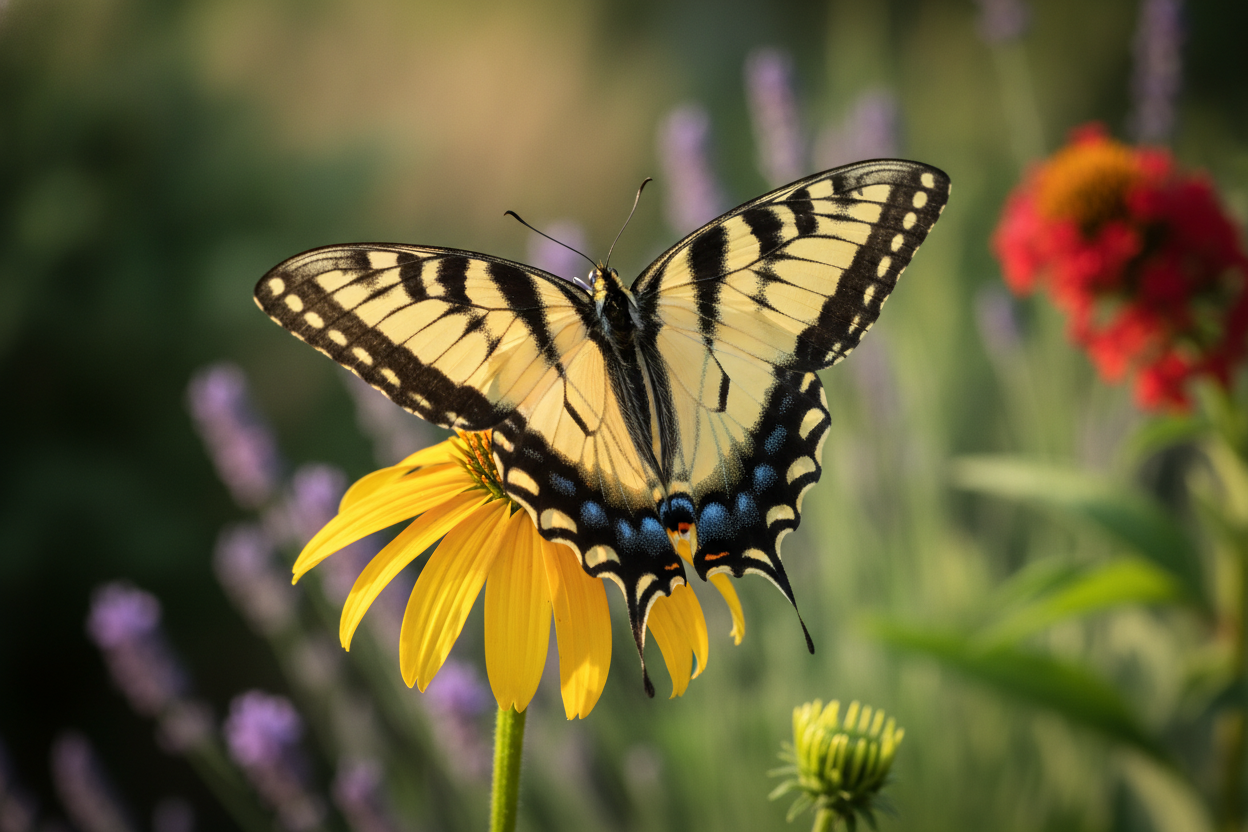
Males are bright yellow with four black “tiger stripes” on each forewing, black borders and a row of blue and orange marks near the tail of each hindwing. Each hindwing has a short tail. On the underside, the forewing has a broken yellow band along the edge.
Two kinds of female
Females come in two forms. The yellow form looks like the male but shows more blue on the hindwings. The dark form is nearly all black or dark gray, with faint tiger stripes visible in good light, especially underneath. The dark form is more common in the South, where the distasteful Pipevine Swallowtail is more abundant. Dark females benefit from looking like that species, because birds that have tasted a Pipevine Swallowtail tend to avoid anything that resembles one. This protective resemblance is called Batesian mimicry.
Lookalikes
- Appalachian Tiger Swallowtail: A similar species of the mountains. It is larger, with a solid yellow bar on the underside of the forewing, and dark females are rare. Telling it from the Eastern Tiger takes close study, and the two are not always separable by sight alone.
- Spicebush Swallowtail: Dark with a blue-green wash on the hindwings and two rows of orange spots under the hindwing.
- Black Swallowtail: Smaller, with rows of yellow dots and an orange spot with a black center on each hindwing.
- Pipevine Swallowtail: Iridescent blue hindwings and a row of pale spots along the wing margin.
The Eastern Tiger Swallowtail life cycle
Eggs
Females lay single round green eggs on host tree leaves, often near nectar sources. The eggs turn yellowish with reddish dots as they develop. Females often lay on small trees and saplings, which are easier to find than leaves high in the canopy.
Caterpillars
Young caterpillars are brown with a large white saddle and look like bird droppings. Later stages are bright green with two big eyespots on the swollen thorax, marked in black, yellow and blue. Together with an orange, forked scent organ called the osmeterium that the caterpillar can push out from behind its head, the eyespots make it look like a small snake. The caterpillar rests on a pad of silk spun on a leaf, and it reaches about two inches long. Just before pupating it turns dark brown.
Chrysalis
The chrysalis is about 1.3 inches long and ranges from off-white to dark brown, often with green and brown patches. It is held upright by a silk girdle on a tree trunk, a fence post or in leaf litter. In cold weather it overwinters, and the adult emerges in spring.
Adult
Adults are active by day and usually solitary, and they are often seen flying high above the tree canopy. Males patrol host-plant areas looking for females and gather in groups on damp ground to take up minerals such as sodium, a habit called puddling. Fresh males do this mostly in their first couple of days. Adults occasionally feed on dung and carrion as well.
When and where to look in the Upstate
In the Southeast, adults can be seen from late winter into fall, with the first butterflies appearing in March or April and numbers peaking in late spring and midsummer. Look along woodland edges, streams, parks and gardens with plenty of flowers. Mud puddles near streams are good for males. Trails in Table Rock and Caesars Head State Parks are good bets, and the best Blue Ridge butterfly spots post covers more. See butterflies in South Carolina by month for timing.
Plants that bring them in
Host trees
Caterpillars eat the leaves of many native trees. Tulip poplar, wild black cherry, sweetbay magnolia and ash are the main ones in the Upstate. Willow and cottonwood also work. You do not need a large yard. A single native tree, or even a young sapling, can host caterpillars. Trees take years to grow, so plant early and choose a species that suits your soil and space. Keep trees away from power lines, septic fields and foundations.
Nectar plants
Adults prefer sturdy flowers they can stand on, especially pink, red and purple ones. Joe-Pye weed, milkweed, bee balm, coneflower, phlox and azaleas all work. See our butterfly garden plant guide for sun, height and bloom time, and host plants by butterfly for the full list.
If you need a spot for flowers, a packet of native butterfly wildflower seed is a simple start. Check scientific names on the label, since generic mixes can include non-native species.
Bring them to your yard
- Plant or protect native host trees, and let a few saplings grow at the edge of the yard.
- Do not spray trees or shrubs with insecticides. Systemic products can reach leaves and nectar.
- Add a mud puddle with damp sand for males. See how to attract butterflies without plants.
- Plant nectar flowers in groups of three or more, in sun, so large butterflies have room to land.
- Leave leaf litter and some tree trunks alone, since chrysalises overwinter there.
Common questions about Eastern Tiger Swallowtails
Why is one female yellow and another black?
Females come in two color forms. The dark form mimics the distasteful Pipevine Swallowtail, which helps protect it from birds, and it is more common in the South.
Is the green caterpillar with big eyes a snake?
No. The eyespots are painted on the caterpillar’s swollen front end to scare off predators. It is harmless to people.
Do the caterpillars harm my trees?
Healthy trees tolerate the chewing, since caterpillars eat only a small share of the leaves. Very young saplings can suffer if many caterpillars feed at once.
Why do I see so many in one muddy spot?
Males gather on damp ground to take up salts and minerals, which they use in reproduction. It is normal behavior.
How can I tell it from the Appalachian Tiger Swallowtail?
The Appalachian species is a bit larger, with a solid yellow bar under the forewing. The difference is subtle and the two overlap in the mountains, so a firm identification often needs expert help.
Our takeaway
The Eastern Tiger Swallowtail is a tree butterfly. If you have a tulip poplar or wild cherry nearby and flowers for the adults, you will probably have tigers, and a young tree planted today will feed generations to come.
Official resources and further reading
- Butterflies and Moths of North America for range maps and sighting records
- Clemson Home and Garden Information Center for plant advice that fits South Carolina
- Xerces Society for pollinator conservation guidance
Related guides
- Host plants by butterfly
- Pipevine Swallowtail profile
- Spicebush Swallowtail identification
- Free butterfly checklist
Spotted one in the Blue Ridge or Upstate? Send us the date and place through our contact page.
Butterfly timing, numbers and plant hardiness vary with weather, year and elevation. This guide is general information. Check with Clemson Extension or another official source before planting trees or shrubs.
Leave a Reply