
Disclosure: Some links on this page are affiliate links. We may earn a commission from qualifying purchases at no extra cost to you. As an Amazon Associate, we earn from qualifying purchases. How affiliate links work.
Spicebush Swallowtail: the woodland swallowtail with the snake-eyed caterpillar
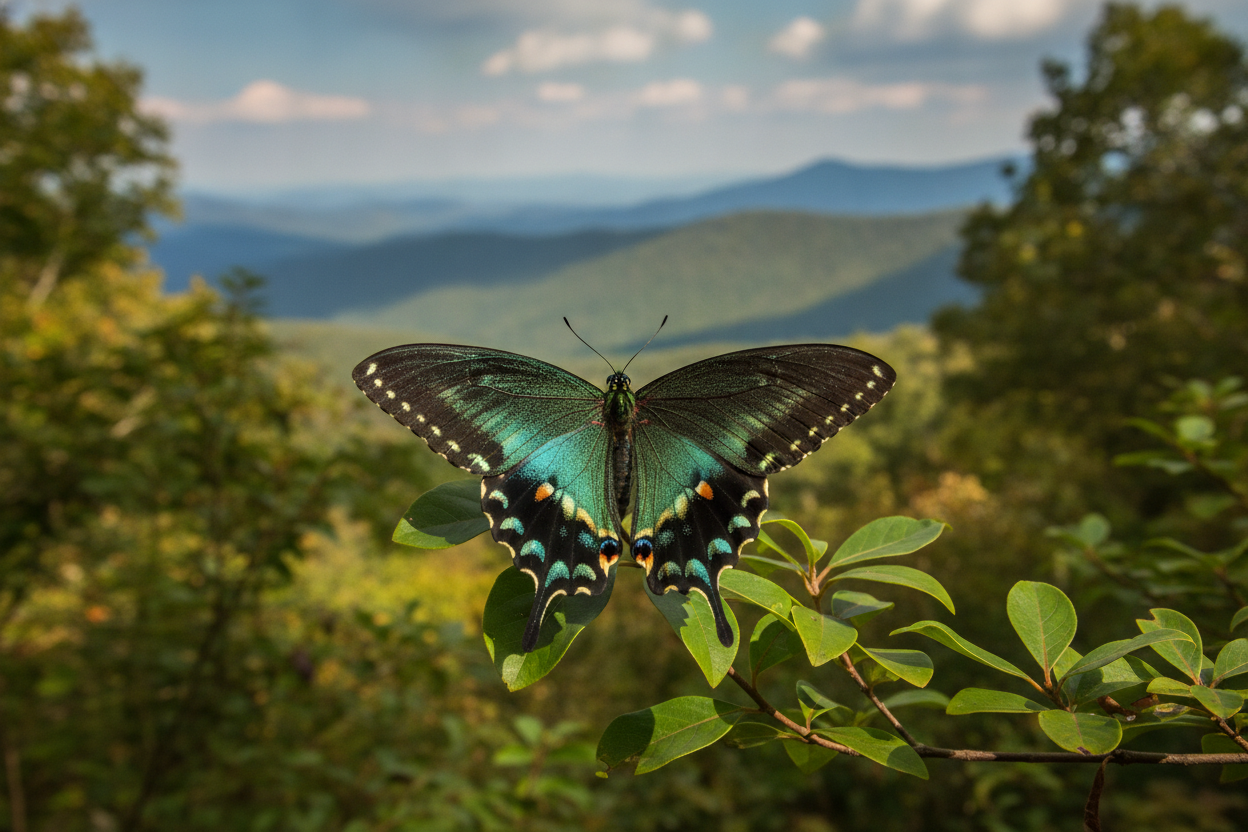
The Spicebush Swallowtail is a dark, blue-green swallowtail of woods, streams and shady gardens. Its caterpillar is one of the most remarkable in the East: a plump green larva with false eyes that folds a leaf into a hiding place. If you have spicebush or sassafras nearby, you may already have this butterfly without knowing it.
This guide shows you how to identify the butterfly and separate it from lookalikes, explains the life cycle and the caterpillar’s tricks, and covers what to plant and when to look in the Upstate.
Spicebush Swallowtail at a glance
- Scientific name: Papilio troilus
- Size: Wingspan of about 3 to 4 inches
- When to look: Spring through fall, with about three broods
- Caterpillar plants: Spicebush and sassafras, with sweetbay and redbay as backups
- Adult nectar plants: Joe-Pye weed, jewelweed, honeysuckle, milkweed, lantana, thistle
- Habitat: Shaded deciduous woods, stream edges, swamps and wooded yards
- Overwinters as: A chrysalis
- Ease of attracting: Moderate (needs spicebush or sassafras)
Ease of attracting runs from Easy (nectar flowers are enough) to Moderate (add a common host plant) to Specialist (needs one particular host plant).
How to identify a Spicebush Swallowtail
Adults are mostly black or dark brown. The hindwing has a half-moon patch of blue-green on males and brighter blue on females, and the forewing has a border of cream-colored oval spots. Both sexes have a row of cream or yellow crescents along the hindwing edge and an orange spot at the wing base. Like other swallowtails, each hindwing has a short tail, which can act as a false head and draw an attack away from the real one.
The best field mark is on the underside. The hindwing has two rows of orange spots with blue or green between them. The Pipevine Swallowtail, a close lookalike, has only a single row.
Lookalikes
- Pipevine Swallowtail: A single row of orange spots underneath and brilliant iridescent blue on the upper hindwing. The Spicebush is a mimic of the pipevine, which is distasteful to birds.
- Black Swallowtail: Yellow spot rows above, and an orange spot with a black center on each hindwing.
- Dark female Eastern Tiger Swallowtail: Larger, and lacking the blue-green hindwing wash.
The Spicebush Swallowtail life cycle
Eggs
Females lay small greenish-white eggs one or two at a time on the leaves of spicebush or sassafras. Look on the undersides of young leaves, in shade or part shade.
Caterpillars
Young caterpillars are brown and resemble bird droppings. They chew from a leaf edge toward the midrib and then fold the leaf over with silk to make a shelter. They hide inside by day and come out to feed at night. If disturbed, they give off a bad smell.
Later stages turn yellow-green, and just before they pupate they may turn orange-yellow. Large false eyes with black pupils and white highlights sit on a swollen front end, making the caterpillar look like a small green snake. When threatened it rears up and pulls its head back, and it can push out a red, forked scent organ called an osmeterium. A leaf with a curled edge is the best sign to look for.
Chrysalis
The caterpillar pupates in a silk harness, often on the underside of a leaf or on a twig near the ground. Chrysalises are green in summer and brown in fall and winter, so they blend with the leaves. Late-season chrysalises overwinter, and adults emerge in spring.
Adult
Adults live only a few days to a couple of weeks. They fly low and fast through shaded woods. Males often cruise swamps and stream edges, and females tend to visit more open areas, looking for host plants. Adults sip nectar and gather at damp sand or soil.
When and where to look in the Upstate
The first adults appear in early spring, and with about three broods you can see them from spring until fall, with the highest numbers in summer. Search moist woods, wooded trails, stream edges and gardens that border woods. Look for Joe-Pye weed and jewelweed in bloom, which they favor in late summer. The best Blue Ridge butterfly spots post lists places to try, and butterflies in South Carolina by month helps with timing.
Plants that bring them in
Host plants
Spicebush (Lindera benzoin) is a native shrub for part shade and moist soil. It grows 6 to 12 feet tall, with yellow flowers in early spring and red berries in fall. Plant a male and a female for berries. Sassafras is a native tree in the same plant family, and the butterfly also uses sweetbay and redbay. See spicebush shrubs for sale. Sassafras spreads by suckers, so give it room.
Nectar plants
Adults visit Joe-Pye weed, jewelweed, bee balm, milkweed, thistle, honeysuckle and lantana. Native plants are the best choice, so choose native coral honeysuckle instead of Japanese honeysuckle, which is invasive. Our butterfly garden plant guide sorts native and non-native options and lists plants to avoid.
Bring them to your yard
- Plant spicebush in part shade where the soil stays moist.
- Do not remove curled leaves without checking for a caterpillar inside.
- Skip insecticides on and near host plants.
- Add a damp patch of sand for adults. See how to attract butterflies without plants.
- Keep a woodland edge or shady corner in the yard. Do not clear it all.
Common questions about Spicebush Swallowtails
Why does my spicebush have folded leaves?
A caterpillar probably made the fold as a shelter. Leave it alone and let it grow.
Is that a snake on my sassafras?
Probably a late-stage Spicebush Swallowtail caterpillar. The false eyes and fat front end are a bluff. It is harmless.
Can I grow spicebush in a small yard?
Yes. Spicebush stays a manageable shrub, though it needs moist soil and some shade. It is a good choice for a rain-garden edge.
How do I tell it from a Pipevine Swallowtail?
Check the underside of the hindwing. The Spicebush has two rows of orange spots, and the Pipevine has one row.
Do the caterpillars hurt the plant?
Established shrubs shrug off the feeding. Very small plants may suffer, so wait until a new plant has several branches before expecting caterpillars.
Our takeaway
A single spicebush in part shade can turn a quiet corner into a nursery for one of the Upstate’s most interesting caterpillars. Pair it with Joe-Pye weed and a damp spot and the adults will follow.
Official resources and further reading
- Butterflies and Moths of North America for range maps and sighting records
- Clemson Home and Garden Information Center for plant advice that fits South Carolina
- Xerces Society for pollinator conservation guidance
Related guides
Spotted one in the Blue Ridge or Upstate? Send us the date and place through our contact page.
Butterfly timing, numbers and plant hardiness vary with weather, year and elevation. This guide is general information. Check with Clemson Extension or another official source before planting.
Leave a Reply