
Disclosure: Some links on this page are affiliate links. We may earn a commission from qualifying purchases at no extra cost to you. As an Amazon Associate, we earn from qualifying purchases. How affiliate links work.
Black Swallowtail: the garden butterfly that raises its young on your herbs
The Black Swallowtail is one of the easiest swallowtails to bring into a home garden, because its caterpillars eat herbs many people already grow. Dill, parsley and fennel are all it needs, and a patch by the kitchen door can host a whole generation. It is common across Upstate South Carolina in sunny gardens, fields and open spaces.
This guide covers how to identify the Black Swallowtail and tell males from females, how to separate it from lookalikes, every stage of its life cycle, where and when to find it, how to plant for it, and what to do when you find caterpillars on your herbs.
Black Swallowtail at a glance
- Scientific name: Papilio polyxenes
- Size: Wingspan of roughly 2.7 to 3.3 inches, with females usually larger than males
- When to look: Spring through fall, with two or three broods in the Upstate
- Caterpillar plants: Parsley, dill, fennel, carrot tops, golden Alexanders and rue
- Adult nectar plants: Milkweed, zinnia, coneflower, phlox, red clover, thistle
- Habitat: Sunny gardens, fields, meadows and roadsides
- Overwinters as: A chrysalis
- Ease of attracting: Easy
Ease of attracting runs from Easy (nectar flowers are enough) to Moderate (add a common host plant) to Specialist (needs one particular host plant).
How to identify a Black Swallowtail
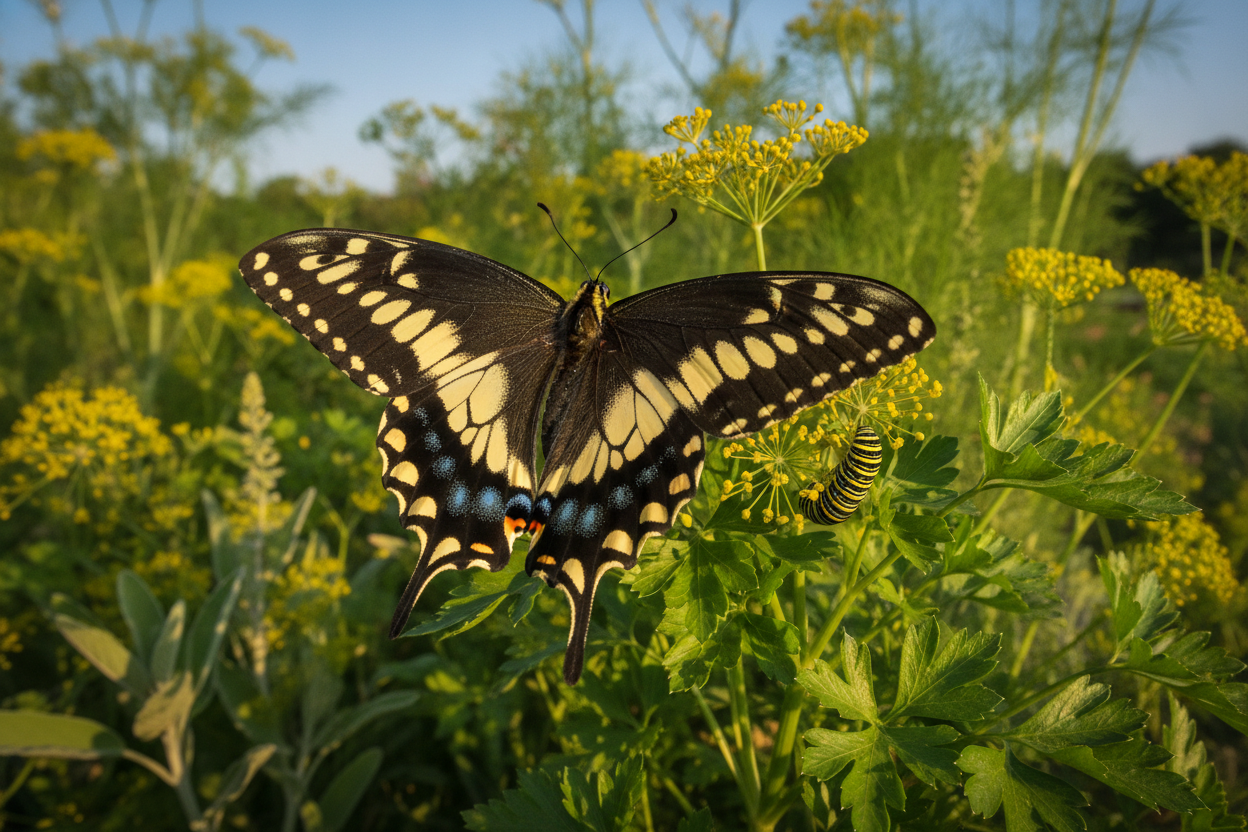
Both sexes have black upper wings with two rows of yellow spots, a round orange spot with a black center near the tail on each hindwing, and blue markings on the hindwings. The sexes differ in how those marks look:
- Males have large, bright yellow spots and only a faint wash of blue between the two rows.
- Females have smaller, paler spots and a much stronger band of blue between the rows. They are also usually a little larger.
The undersides look much the same in both sexes, with rows of yellow-orange spots that echo the pattern above. Flight is steady and fluttering rather than gliding, and the butterfly often keeps its wings quivering as it feeds.
Lookalikes in the Upstate
Several dark swallowtails share the Upstate, and they are often confused. Check the pattern, not just the color, and take photos of the upper side and underside when you can.
- Pipevine Swallowtail: Dark above with bright iridescent blue hindwings and no yellow band on the upper wings. Black Swallowtails have obvious yellow spots on the upper wings.
- Spicebush Swallowtail: Blue-green on the hindwings with pale spots along the edge, and two rows of orange spots under the hindwing.
- Dark female Eastern Tiger Swallowtail: Larger, and nearly all dark, sometimes with faint tiger stripes visible in good light.
Female Black Swallowtails are thought to gain some protection from looking like the distasteful Pipevine Swallowtail, a case of mimicry that several of the Upstate’s swallowtails share.
The Black Swallowtail life cycle
Like all butterflies, the Black Swallowtail goes through four stages: egg, caterpillar, chrysalis and adult. Knowing what each looks like helps you avoid destroying them by accident.
Eggs
Females lay single, pale yellow, round eggs on host plants, often on new growth near the top of the plant, and occasionally on flowers. An egg hatches in about four to nine days, depending on the weather. Look for them on the leaves of dill, fennel and parsley, and check both sides of the leaf.
Caterpillars
Caterpillars are often called parsleyworms. They grow through five stages, called instars, and the larval stage typically lasts about two to four weeks, longer in cool weather.
- Young caterpillars are small, dark and spiny, with a pale saddle across the middle. They look like bird droppings, which helps them avoid being eaten.
- Older caterpillars are bright green with black bands and yellow or orange dots. The spines are gone.
- The osmeterium: If disturbed, the caterpillar pushes out a forked, orange, fleshy organ behind its head, which smells unpleasant. It is a defense against predators and harmless to people.
Caterpillars absorb compounds from their host plants that make them taste poor to birds. Predators such as wasps, spiders, stink bugs and birds still take many of them.
Chrysalis
When fully grown, a caterpillar leaves the host plant and wanders, sometimes many feet, to find a stem, fence or wall. It attaches itself with a silk pad at the tail and a silk loop around its middle, then sheds its skin to reveal the chrysalis. Summer chrysalises are green or brown and take about two weeks to develop. A green chrysalis often darkens shortly before the adult emerges. Chrysalises that form late in the year spend the winter this way, and the adult emerges in spring.
Adult
Adults typically emerge in the morning. They dry their wings for an hour or two, then fly. Males emerge first and defend territories, often on a hill or other prominent spot, where females come to mate. Adults feed on nectar and live a few weeks.
When and where to look in the Upstate
Adults begin flying in spring and continue until the first hard frosts, with new broods through summer. Numbers peak in late spring and again in late summer. Look in sunny gardens with herbs and flowers, in open fields and along roadsides and powerline cuts. Males patrol low over the ground in search of females, and both sexes visit flowers in the morning and early evening. For places to go, see the best Blue Ridge butterfly spots, and for a month-by-month view see butterflies in South Carolina by month.
Plants that bring them in
Plants for caterpillars
Dill, fennel and parsley are the quickest to grow from seed, and they thrive in full sun. A pack of dill, fennel and parsley seeds covers the kitchen and the caterpillars. Carrot tops also work. For a native option, golden Alexanders is a spring-blooming plant from the same family. Rue is another host, though it is less common in gardens. Wild carrot, or Queen Anne’s lace, is a non-native roadside plant that also feeds them.
Never forage for wild plants in this family to eat. Poison hemlock grows in some areas and looks like wild carrot, and it is deadly. Stick to herbs you planted and can identify.
Plants for adults
Adults visit many nectar flowers, especially pink, purple, yellow and red ones. Zinnias, coneflowers, milkweed, phlox, red clover and thistles work well. Our butterfly garden plant guide lists sun, height and bloom time for each, sorted into native and non-native choices.
Bring them to your yard
- Grow extra dill and parsley so caterpillars do not compete with your harvest. Put them in full sun.
- Do not spray herbs with insecticides, including products labeled organic.
- Check stems for caterpillars and chrysalises before you cut or prune.
- Plant nectar flowers with overlapping bloom times so adults have food all season.
- Add a shallow mud puddle for males. See how to attract butterflies without plants.
For more on laying out a garden, see our guide to starting a butterfly garden. If you find caterpillars on your herbs, our post on caterpillars on parsley and dill explains what to do.
Common questions about Black Swallowtails
Why are there caterpillars on my parsley?
They are almost certainly Black Swallowtails. Parsley, dill and fennel are their food plants. They do no harm to people and turn into butterflies.
Will they eat all of my herbs?
They can strip a small plant quickly. Grow extra, and the plants usually regrow once the caterpillars leave.
What is the orange horn the caterpillar shows?
It is the osmeterium, a scent organ the caterpillar uses to startle predators. It is harmless to people.
How can I tell a male from a female?
Males have bigger, brighter yellow spots and little blue. Females have smaller, paler spots and a strong blue band on the hindwing.
Where do the caterpillars go to form a chrysalis?
They often leave the plant and travel several feet to a stem, fence, wall or eave. Do not move a chrysalis once it is attached.
Is it safe to eat herbs that caterpillars have fed on?
Yes, once you rinse them well. The caterpillars are not harmful, but wash all garden herbs before eating.
Our takeaway
If you only plant one thing for butterflies, a row of dill and parsley is hard to beat. It is cheap, quick and brings in one of the Upstate’s most attractive swallowtails.
Official resources and further reading
- Butterflies and Moths of North America for range maps and sighting records
- Clemson Home and Garden Information Center for plant advice that fits South Carolina
- Xerces Society for pollinator conservation guidance
Related guides
- Host plants by butterfly
- Eastern Tiger Swallowtail guide
- Spicebush Swallowtail identification
- Free butterfly checklist
Spotted one in the Blue Ridge or Upstate? Send us the date and place through our contact page.
Butterfly timing, numbers and plant hardiness vary with weather, year and elevation. This guide is general information. Check with Clemson Extension or another official source before planting, and follow local rules on protected areas.
Leave a Reply