
Disclosure: Some links on this page are affiliate links. We may earn a commission from qualifying purchases at no extra cost to you. As an Amazon Associate, we earn from qualifying purchases. How affiliate links work.
Pipevine Swallowtail: the blue-black swallowtail that birds avoid
The Pipevine Swallowtail glows with metallic blue on its hindwings and carries a built-in warning for birds: it tastes bad. That chemical defense is so successful that several other Upstate butterflies copy its look to gain protection. It is also one of the more specialized swallowtails, because its caterpillars eat only pipevines.
This guide covers how to identify the Pipevine Swallowtail and its mimics, the life cycle, where and when to look, and how to plant native pipevine while avoiding the tropical species that can kill the caterpillars.
Pipevine Swallowtail at a glance
- Scientific name: Battus philenor
- Size: Wingspan of about 2.75 to 5 inches
- When to look: Spring through fall, with a spring and a summer peak
- Caterpillar plants: Native pipevines, such as woolly Dutchman’s pipe and Virginia snakeroot
- Adult nectar plants: Thistle, phlox, ironweed, azalea, milkweed, bee balm, lantana
- Habitat: Open woods, meadows, stream corridors and gardens
- Overwinters as: A chrysalis
- Ease of attracting: Specialist (needs pipevine)
Ease of attracting runs from Easy (nectar flowers are enough) to Moderate (add a common host plant) to Specialist (needs one particular host plant).
How to identify a Pipevine Swallowtail
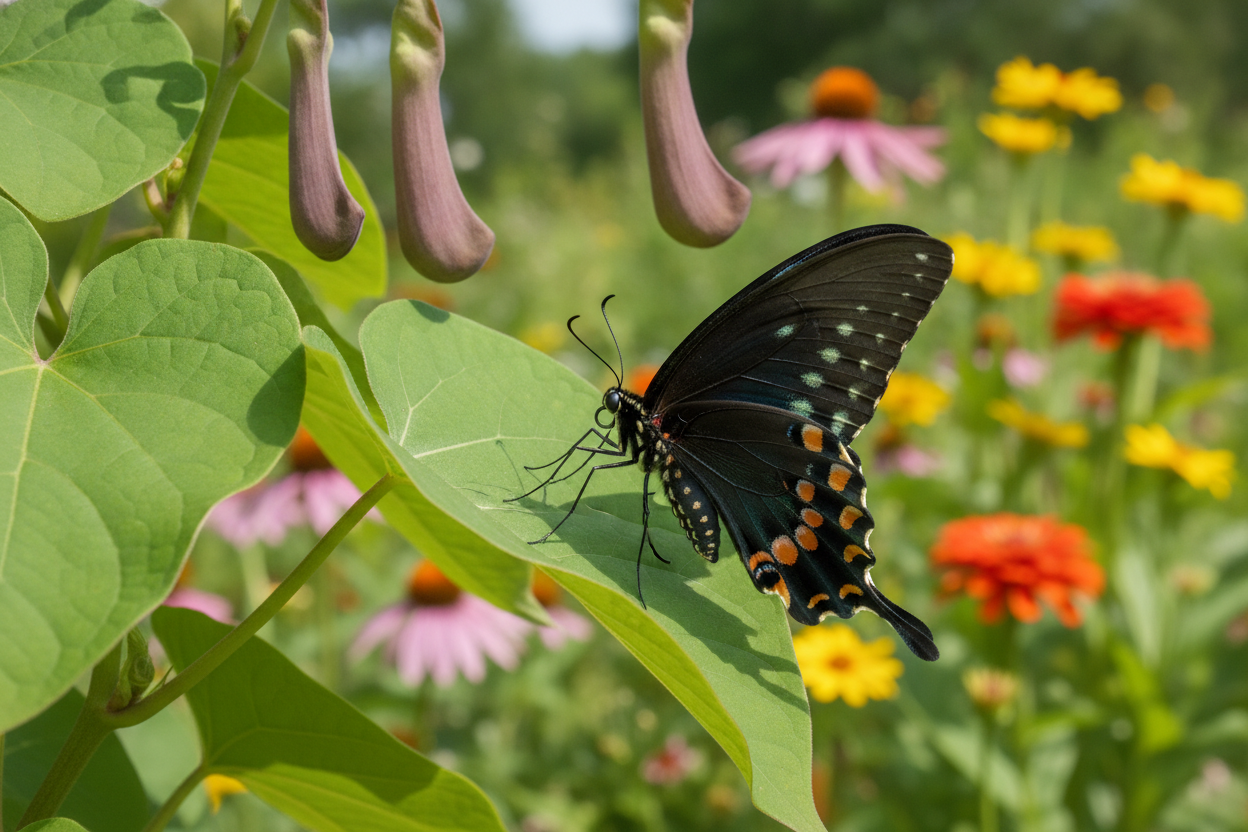
The upper wings are black. In males, the hindwings flash brilliant iridescent blue, and in females the blue is duller. A row of pale spots follows the edge of the hindwing. The underside of the hindwing has a row of large, bright orange spots against a blue sheen, and this single row is the best field mark. Butterflies at rest often show only the underside.
Mimics: who copies the pipevine
Birds that taste a Pipevine Swallowtail learn to avoid it. Several tasty butterflies take advantage by looking like it, which is called Batesian mimicry. In the Upstate, the mimics include:
- The dark form of the female Eastern Tiger Swallowtail
- The Spicebush Swallowtail
- The female Black Swallowtail
- The Red-spotted Purple
To tell the model from its copies, look at the underside of the hindwing. The Pipevine has a single row of orange spots. The Spicebush has two rows. The Red-spotted Purple is a different kind of butterfly and does not have tails.
The Pipevine Swallowtail life cycle
Eggs
Females lay small, bumpy red-orange eggs in clusters on pipevine stems and the underside of leaves, often in sun. Unlike most swallowtails, which lay singly, the pipevine lays in groups.
Caterpillars
Caterpillars are dark brown to black and velvety, about two inches long when full grown, with rows of fleshy filaments and bright orange spots at the tips of the body tubercles. Young caterpillars feed in groups and strip a vine quickly. Later they spread out. When fully grown they leave the vine and wander for days before settling to pupate.
Pipevine contains aristolochic acids. The caterpillars store these chemicals, and they pass to the chrysalis and adult. The chemicals make the butterfly unpalatable, and the bright orange spots on the caterpillar are thought to warn off predators. Anole lizards and a few other animals still eat them.
Chrysalis
The chrysalis is green or brown and wide, with leaf-like flanges along the sides. It is often attached high on a tree trunk, wall or fence, away from the host plant. The pattern of the adult wings can be seen through the shell before it emerges. In cooler areas, the chrysalis overwinters.
Adult
Adults feed on thistle, phlox and other flowers, always with their wings fluttering. Males visit mud for minerals and court females by hovering over them and releasing a scent.
When and where to look in the Upstate
Adults fly from spring through fall, with a flush in spring and another in late summer. Look in open woods, along streams, in meadows and in gardens near native pipevine. Walk trails where pipevine climbs on trees, and watch for egg clusters on vines. Check out the best Blue Ridge butterfly spots, and see butterflies in South Carolina by month.
Plants that bring them in
Pipevine: plant the right one
Native pipevines are the host plants. Woolly Dutchman’s pipe (Aristolochia tomentosa) and pipevine (A. macrophylla) are vines for a fence or arbor, and Virginia snakeroot (A. serpentaria) is a small woodland plant. Look for a nursery that sells native stock, and check scientific names.
Warning: Do not plant tropical pipevines, such as Aristolochia elegans or giant Dutchman’s pipe. They are toxic to Pipevine Swallowtail caterpillars and can act as a trap that kills the young. The native species are safe. All pipevines are poisonous to people and pets if eaten, so plant them out of reach of children and animals and wash your hands after handling.
Nectar plants
Adults visit thistle, phlox, ironweed, bee balm, milkweed and azalea. For other choices, see our butterfly garden plant guide, which separates native and non-native plants and lists those to skip.
Bring them to your yard
- Plant native pipevine on a trellis or fence in a sunny to part-shade spot.
- Expect the vine to be stripped. It usually regrows. Plant more than one.
- Avoid insecticides and never plant tropical pipevines.
- Leave chrysalises where they are, and check fences and walls before painting or pressure washing.
- Offer a mud puddle for males. See how to attract butterflies without plants.
Common questions about Pipevine Swallowtails
Is the Pipevine Swallowtail poisonous?
It is distasteful and mildly toxic to many predators, but it is not dangerous to people who just look at it. Wash your hands after touching one.
Why do the caterpillars strip my vine?
Young caterpillars feed together and can eat most of the leaves. A healthy vine usually regrows. Plant extra pipevine if you want them every year.
Which pipevine should I buy?
Choose a native species, such as woolly Dutchman’s pipe, pipevine or Virginia snakeroot. Avoid tropical species with huge flowers.
How can I tell it from a female Eastern Tiger Swallowtail in dark form?
The dark tiger is larger, and its hindwings have no strong blue sheen. The Pipevine shows a single row of orange spots underneath.
Our takeaway
Plant a native pipevine and you can attract one of the Upstate’s most distinctive butterflies. Just be sure it is the right species.
Official resources and further reading
- Butterflies and Moths of North America for range maps and sighting records
- Clemson Home and Garden Information Center for plant advice that fits South Carolina
- Xerces Society for pollinator conservation guidance
Related guides
- Host plants by butterfly
- Red-spotted Purple guide
- Spicebush Swallowtail identification
- Free butterfly checklist
Spotted one in the Blue Ridge or Upstate? Send us the date and place through our contact page.
Butterfly timing, numbers and plant hardiness vary with weather, year and elevation. Pipevines are poisonous to people and pets. This guide is general information. Check with Clemson Extension or another official source before planting.
Leave a Reply