
Disclosure: Some links on this page are affiliate links. We may earn a commission from qualifying purchases at no extra cost to you. As an Amazon Associate, we earn from qualifying purchases. How affiliate links work.
Red-spotted Purple: the woodland butterfly that mimics a swallowtail
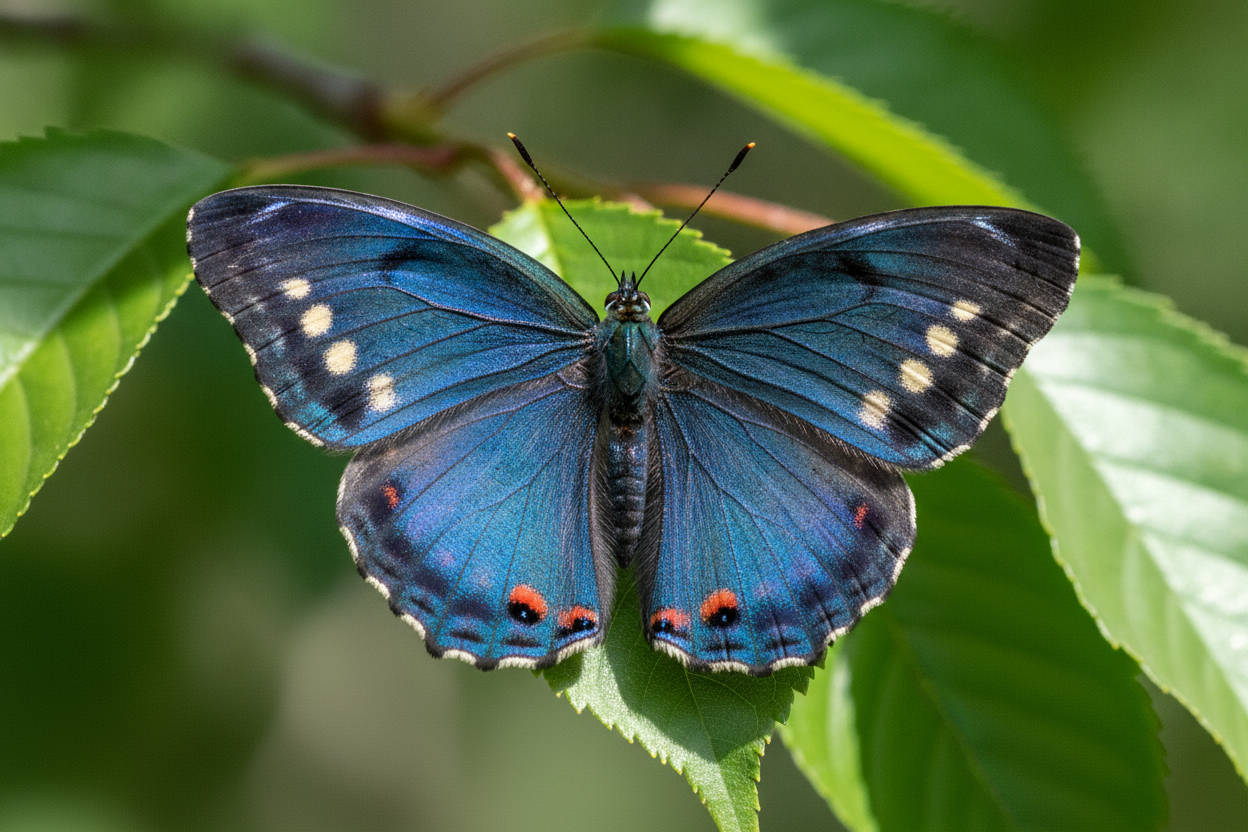
The Red-spotted Purple is a dark, blue-green butterfly of shady woods and forest edges that borrows the look of the Pipevine Swallowtail to avoid being eaten. It rarely visits flowers. Instead you find it on rotting fruit, tree sap, damp ground and even animal droppings, perched in a sunny spot on a leaf.
This guide covers how to identify it, how it differs from its northern relative, its life cycle, when and where to find it, and how to attract it with fruit and cherry trees.
Red-spotted Purple at a glance
- Scientific name: Limenitis arthemis astyanax
- Size: Wingspan of about 3 to 3.5 inches
- When to look: April through October, with two broods
- Caterpillar plants: Black cherry, willow, poplar and other trees
- Adult foods: Rotting fruit, tree sap, dung, some small white flowers
- Habitat: Deciduous woods, forest edges, shady roads and streams
- Overwinters as: A half-grown caterpillar in a rolled leaf shelter
- Ease of attracting: Moderate (needs host trees and fruit)
Ease of attracting runs from Easy (nectar flowers are enough) to Moderate (add a common host plant) to Specialist (needs one particular host plant).
How to identify a Red-spotted Purple
From above, it is dark with no white band, and the hindwings shimmer blue to blue-green, especially in sun. A row of blue spots runs along the edge. Underneath, it has several red or orange spots at the wing base and a row of red spots along the edge, with bluish marks on the margin. The wings are rounded and lack the tails of a swallowtail.
A harmless copy of a toxic butterfly
The Red-spotted Purple is a palatable species that looks like the distasteful Pipevine Swallowtail. Birds that have learned to avoid the pipevine tend to leave this butterfly alone. This protective resemblance is called Batesian mimicry. To tell them apart, look for tails (the pipevine has them, the purple does not) and for the pattern of spots on the underside.
Relationship to the White Admiral
Farther north, the closely related White Admiral has a bold white band across both wings. The two belong to the same species group and interbreed where their ranges meet, in the Northeast and around the Great Lakes, producing mixed forms. In the Upstate you will see the Red-spotted Purple form, and a butterfly with a white band here is much more likely to be a different species, such as a Viceroy.
The Red-spotted Purple life cycle
- Eggs: Females lay single eggs on the tips of leaves of host trees.
- Caterpillars: Young ones are brown with yellow borders and look like bird droppings. They feed from the leaf tip and leave a rib of the leaf as a perch. Mature caterpillars are olive-brown with fleshy bumps and a pale saddle.
- Winter: Most first-brood caterpillars build a small shelter from a rolled leaf, called a hibernaculum, and spend the winter half-grown. Some mature during the summer and form a second brood in early fall.
- Chrysalis: The chrysalis hangs from a twig, is pale and mottled, and lasts about 10 to 14 days.
- Adults: They live about one to two weeks. They are active from morning until after dusk.
Males defend sunny perches on leaves, such as maple, elm or raspberry, and chase rivals in short aerial contests. Flight is low, often just two or three feet off the ground, alternating between flapping and gliding.
When and where to look in the Upstate
Adults fly from spring into fall, with peaks in late spring and midsummer. Look along shady trails, forest edges, streams and wooded roads, on damp ground, tree sap and fallen fruit. In a yard, check overripe fruit, compost piles and wet gravel. See the best Blue Ridge butterfly spots and butterflies in South Carolina by month.
Plants and foods that bring them in
Host trees
In the Southeast, the most important host is black cherry, a large native tree. Other members of the rose family can be used, and willows and poplars are hosts as well. Plant a native tree if you have room, and avoid pruning cherry trees heavily in summer.
Fruit and sap
Adults feed mostly on rotting fruit, sap and similar sugars. Set out overripe banana or orange in a shady spot and replace it often. A butterfly feeder can hold the fruit, though a simple plate works. See how to attract butterflies without plants for more.
Flowers
They do take nectar from some small white flowers, such as viburnum and spirea. Our butterfly garden plant guide lists other choices.
Bring them to your yard
- Keep native cherry, willow or poplar trees on the property.
- Put out overripe fruit on a plate in a shady spot near trees.
- Add a mud puddle with a rock or two for perching.
- Leave leaf litter and fallen leaves under the trees.
- Avoid insecticide sprays, especially on trees in spring.
Common questions about Red-spotted Purples
Why does it not visit my flowers?
This butterfly prefers rotting fruit, sap and damp ground. Offer fruit instead of more flowers.
Is it a swallowtail?
No. It belongs to the brushfoot family and has no tails. It only resembles a swallowtail.
Where do the caterpillars spend winter?
Half-grown caterpillars shelter in a rolled leaf attached to a twig, called a hibernaculum, and resume feeding in spring.
Is it the same as a Viceroy?
No. The Viceroy is orange like a small monarch, with a black stripe across the hindwing.
Our takeaway
To attract Red-spotted Purples, think trees and fruit instead of flowers. A native cherry, a plate of ripe banana and a damp patch will do more than another flower bed.
Official resources and further reading
- Butterflies and Moths of North America for range maps and sighting records
- Clemson Home and Garden Information Center for plant advice that fits South Carolina
- Xerces Society for pollinator conservation guidance
Related guides
- Pipevine Swallowtail profile
- How to attract butterflies without plants
- Host plants by butterfly
- Free butterfly checklist
Spotted one in the Blue Ridge or Upstate? Send us the date and place through our contact page.
Butterfly timing, numbers and plant hardiness vary with weather, year and elevation. This guide is general information. Check with Clemson Extension or another official source before planting.
Leave a Reply