
Disclosure: Some links on this page are affiliate links. We may earn a commission from qualifying purchases at no extra cost to you. As an Amazon Associate, we earn from qualifying purchases. How affiliate links work.
Great Spangled Fritillary: the big orange summer butterfly of meadows and mountain edges
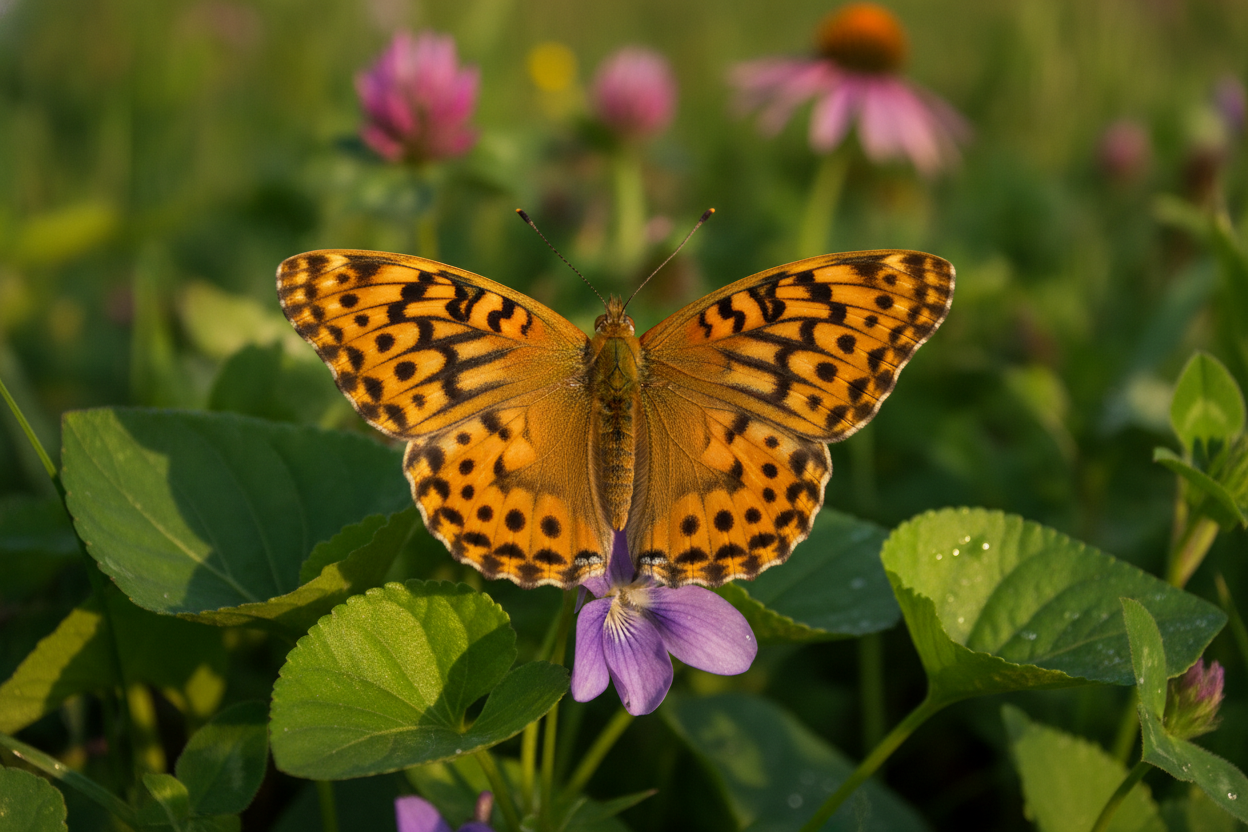
The Great Spangled Fritillary is a large, bright orange butterfly that appears in early summer on coneflowers, milkweed and thistle. Its underwings are covered in silvery spots, which give it its name. It is common in the Blue Ridge and foothills and is one of the best butterflies for a beginner to learn, because it is big, easy to see and often tolerates a close look while it feeds.
Its caterpillars eat violets, and its unusual life cycle means the adults spend part of summer resting before they lay eggs. This guide covers identification, lookalikes, the life cycle, when and where to look, and what to plant.
Great Spangled Fritillary at a glance
- Scientific name: Speyeria cybele
- Size: Wingspan of about 2.4 to 3.5 inches
- When to look: Early summer through early fall, with peak numbers in midsummer
- Caterpillar plants: Native violets
- Adult nectar plants: Milkweed, coneflower, bee balm, thistle, ironweed, Joe-Pye weed
- Habitat: Moist meadows, woodland edges and open fields
- Broods: One a year
- Ease of attracting: Moderate (needs violets)
Ease of attracting runs from Easy (nectar flowers are enough) to Moderate (add a common host plant) to Specialist (needs one particular host plant).
How to identify a Great Spangled Fritillary
The upper side is orange with black dashes near the base of the forewing, irregular black marks at the base of the hindwing and two rows of black crescents along the wing edges. The underside gives the butterfly its name. The hindwing has a wide yellowish-tan band and large silvery spots, and a brown band with silver triangles runs along the edge. Silver spots also mark the tip of the forewing.
- Males are brighter orange.
- Females are darker and a little larger, often with a bit of dusky shading near the wing base.
Lookalikes
The Aphrodite Fritillary, a close relative that also lives in the Appalachians, is very similar. The Great Spangled has a wide light band on the underside of the hindwing, and black dashes rather than spots near the forewing margin. Telling them apart in the field is hard even for experts, so photograph the underside. The Pearl Crescent is much smaller. The Variegated Fritillary is smaller and lacks the large silver spots, and it uses passionflower instead of violets.
The Great Spangled Fritillary life cycle
This butterfly has one brood a year, and its timing is unusual:
- Early summer: Adults emerge, with males appearing before females. They feed on nectar.
- Midsummer: Females generally rest in cool, shady places and do not lay eggs right away. This summer pause is a behavior sometimes called aestivation.
- Late summer and fall: Females lay eggs near violets, often on leaf litter or plant stems and not on the leaves.
- Fall and winter: The eggs hatch, and the tiny caterpillars wait through winter without eating.
- Spring: Caterpillars begin feeding on fresh violet leaves, mostly at night, and then pupate.
The caterpillars are dark and spiny, with orange or reddish spines and a pale stripe. They are harmless to touch for most people but look intimidating. The chrysalis is dark brown and spiky and hangs near the ground.
The details of this life cycle are well established for fritillaries in general, but local timing varies. If you want to document it, record dates and places with our free butterfly checklist.
When and where to look in the Upstate
Look from about June through September, with the biggest numbers in July. Moist meadows, powerline cuts, woodland edges and mountain overlooks are the best places, and the butterflies are often found on the flowers in the late morning. The best Blue Ridge butterfly spots post lists parks to try, and butterflies in South Carolina by month helps with timing.
Plants that bring them in
Violets for the caterpillars
Native violets are the host plants, including common blue violet, round-leaf violet and arrow-leaf violet. They grow in part shade at the edges of beds and under trees, and many gardeners already have them in the lawn. Let violets spread in a corner of the yard and mow around them. Look for native violet plants if you do not have any. Do not use herbicides on violets, and skip weed-and-feed lawn products.
Nectar plants
Adults love coneflower, common milkweed, bee balm, thistle, ironweed and Joe-Pye weed. Plant them in sun in groups of three or more. The butterfly garden plant guide sorts native and non-native choices.
Bring them to your yard
- Let violets grow in part shade, and keep lawn chemicals off them.
- Plant sun-loving nectar flowers that bloom in June and July.
- Leave leaf litter in beds and under trees, because eggs and caterpillars wait there through winter.
- Mow later and higher in the area near violets.
- Keep a cool, shady spot for resting females.
Common questions about Great Spangled Fritillaries
Why do the females seem to vanish in midsummer?
Females generally rest for weeks in shady places before they lay eggs, so you see fewer of them until late summer.
Are the spiny caterpillars dangerous?
Fritillary caterpillar spines are generally not stinging, but avoid handling them, and wash your hands if you do.
Is a violet in my lawn a good thing?
Yes. Native violets feed fritillary caterpillars and also provide early food for bees. Let a patch grow.
How do I tell it from an Aphrodite Fritillary?
Look at the underside of the hindwing for a wide, pale band. The two species overlap in the mountains and can be hard to separate, so photograph both wing surfaces.
Our takeaway
If you want fritillaries, let the violets grow, plant coneflower and milkweed, and keep the lawn chemicals away. The butterflies will come on their own schedule.
Official resources and further reading
- Butterflies and Moths of North America for range maps and sighting records
- Clemson Home and Garden Information Center for plant advice that fits South Carolina
- Xerces Society for pollinator conservation guidance
Related guides
- Host plants by butterfly
- Pearl Crescent ID tips
- Butterflies in South Carolina by month
- Free butterfly checklist
Spotted one in the Blue Ridge or Upstate? Send us the date and place through our contact page.
Butterfly timing, numbers and plant hardiness vary with weather, year and elevation. This guide is general information. Check with Clemson Extension or another official source before planting.
Leave a Reply